Thursday, January 31, 2008

Siegel on the Stars and Bars

My good friend Mike Siegel takes on the Confederate Flag in South Carolina

Mike makes two observations:

(1) Even if the Civil War wasn’t “about” slavery, the issue was so entrenched with the war, the distinction is academic. Without slavery, there would have been no war.

(2) It doesn’t matter if blacks’ offense at the Confederate flag is rational or not. The flag is supposed to represent all the people of the state. If some fraction finds the flag offensive — whether their offense is reasonable or not — it should be changed.

It's pretty hard to argue that the Civil War wasn't about slavery, especially in South Carolina. Consider the following snippet from South Carolina's Articles of Secession:

[p17]
The Constitution of the United States, in its fourth Article, provides as follows:

[p18]
"No person held to service or labor in one State, under the laws thereof, escaping into another, shall, in consequence of any law or regulation therein, be discharged from such service or labor, but shall be delivered up, on claim of the party to whom such service or labor may be due."

[p19]
This stipulation was so material to the compact, that without it that compact would not have been made. The greater number of the contracting parties held slaves, and they had previously evinced their estimate of the value of such a stipulation by making it a condition in the Ordinance for the government of the territory ceded by Virginia, which now composes the States north of the Ohio River.

This is the first substantive issue raised in the document, and it recurs throughout. To me, that says that it was the most important issue on their minds.

On the other hand, I don't think that the display of the confederate flag today is about slavery or even racism. I think it stems more from the fact that all people, regardless of their station in life, want to believe that they are descended from distinguished and honorable forebears. I expect there is no history so infamous that the descendants of the perpetrators will not try to whitewash it, or failing that suppress it.

I'm generally sympathetic to this impulse. It seems unjust to hold people responsible for events in which they had no say. However, distorting the historical record is the wrong way to deal with the problem. The right way involves a frank admission of what happened in the past, a recognition that we are not our ancestors, and a resolve that we will be better than they were. That, however, is a lot of verbiage, so maybe we need a name for the concept that is a little punchier, something like "Truth and Reconciliation". It has kind of a ring to it.

That said, I do have to object to the "whether they are reasonable are not" comment. Surely what we mean by an "unreasonable" objection is that it should not be heeded. If not, then I wonder, what exactly is the difference between a reasonable and an unreasonable objection? Furthermore, rejecting any standard of reasonableness when "some fraction of the population" objects to something seems like bad policy. Surely there exists a fraction that is too small or an objection that is too wacky to merit serious consideration. The point is that that's not the case here. Trying to weasel on whether or not the objections are reasonable only weakens the argument.

Thursday, January 24, 2008

Seven. Billion. Dollars.

Hold that number in your mind for a minute. Try to visualize it as, say, a stack of $100 bills (apparently about 7.5 km, in case you were wondering).

Now, there's this bank in France, see. And the bank employed this dude, you see. He was about 30 years old, and for some reason I imagine him having a goatee, but I confess that's just my own embellishment. So, you'll never guess what this dude did. Get this, he lost over $7 billion for his employer. Whoops. How does a 30-year old goatee-guy get hold of $7 billion without somebody, you know, asking him what he plans to do with it. I can't even get a measly $10k for new research equipment without navigating a labyrinth of forms and approvals, and I don't even have a goatee.

Sometimes You Even Need a Weatherman to Know Which Way the Wind Doesn't Blow

I'm not a big fan of January. It's cold, the sun goes down before I leave work, it's cold, there's salt all over the roads, and most of all, it's really, really cold. The one good thing about January, however, is that organizations like the American Astronomical Society and the American Meteorological Society hold their annual meetings, and for a brief time science gets to be in the news without being pressed into service as a foot soldier for politics.

This week's AMS meeting saw the publication of a study indicating that warmer oceans could reduce the number and intensity of hurricanes striking the US. This result is contrary to the conventional wisdom that warmer sea surface temperatures (SSTs) will result in more and stronger hurricanes. The culprit, it seems, is wind shear. Wind shear disrupts tropical cyclones, and the study finds that higher SSTs produce more shear; thus, fewer cyclones. One particularly interesting feature of this study is that it is based on observational data, rather than on climate model calculations.

If this study is borne out, then it will add an interesting new dimension to the climate debate. In practice it is unlikely that any climate change will be unambiguously good or bad; rather, there will probably be some who are helped and some who are harmed. This, then, is where the future of climate research lies: not in pointless debates over whether or not climate change is happening, but in serious study about the likely effects, for good or ill, of the change that is always happening.

Tuesday, January 22, 2008

We're back

It's amazing how much catching up there is to do after a measly two weeks away visiting the family. I finally managed to slap together a post tonight, and I've got a couple more things I want to write about when I have time; I think Jennifer does too.

Until then, um, well, Happy New Year?

The Daily Show - Wait and Switch

The Daily Show takes on lobbyists. Apparently there is a law afoot (for now, still just a bill) that would prohibit lobbyists from hiring people to wait in line for front-row seats at meetings of committee meetings and the like. My question: who wins and who loses if this bill passes?

First, let's set aside the notion, compelling though it may be, that lobbyists are anthropomorphic pond scum bent on buying out our government. There are good causes, and there are bad causes, all of which have lobbyists. For example, I once met a lobbyist for the National Science Foundation. I presume we can all agree that we're in no danger of the government selling out to… the government.

In fact, consider this: there are 300 million people living in this country. With only 535 members of the two houses of Congress, that's roughly 600,000 apiece. If a legislator spends all day, every day, 365 days a year talking to citizens, never stopping to sleep, that would give us each about 50 seconds a year to make our concerns known--to just one member out of 535. Clearly, we can't all go up to Capitol Hill and make our concerns known. What we can do, however, is to get together with a bunch of like-minded people and hire a spokesman to go up to Capitol Hill for us and tell our concerns to as many Congresspeople as will listen. That is, we could hire a lobbyist. In this sense lobbyists perform a valuable service. Without them, only a select few would get to express their views to the Congress, and I have a hunch that it wouldn't be you and me.

It's not a perfect system, I concede. People with more money can hire more and better lobbyists. Some lobbyists engage in questionable practices, if not out-and-out bribery; however, sadly, it's the best we've got.

But, we were talking about the effects of the new (proposed) law. It turns out that you have to wait quite a long time to get into these meetings where you can get on with educating legislators, expressing concerns, and whatnot. And it turns out that good lobbyists are in demand, so they command shockingly high salaries (as anyone who has competed in the housing market in the DC area will ruefully tell you). Consequently, having them wait around in a queue for the legislators to show up is a tremendous waste of money. Better to hire a bike messenger (or even an "unemployed puppeteer") at much less cost to wait while the expensive guy does something productive (inasmuch as the deadweight losses associated with influencing government can be considered "productive" -- work with me here).

So, what happens if you can't hire cheap placeholders for the line? Well, then you have to have the actual lobbyists do it, which means that each one accomplishes a lot less in a day. Equivalently, lobbying gets a lot more expensive. Who loses from this (apart from the placeholders themselves, of course--apparently the pay is pretty good)? At the margins, every cause will consume less political lobbying, but for interest groups who can already can afford to do only a little bit, that marginal decrease translates to a huge reduction in their effectiveness at influencing policy. Conversely, well-funded interests may at the margin get fewer hours of face time with legislators, but will overall be more effective due to reduced competition from other interests.

Conclusion: Congressmen Cohen's bill, however well-intentioned it may be, will probably have the effect of concentrating influence in the best-funded special interest groups while driving niche interests out of the political process.

Saturday, December 15, 2007

Sometimes You Do Need a Weatherman to Know Which Way the Wind Blows

I found this story (found over at Cafe Hayek) about the emergency management strategies of big box chains to be unspeakably cool:
Along with traditional measures, such as wind speed, rain levels and satellite images, McDonald relies on hurricane-tracking software that uses 12 models to predict whether potential storm tracks lead toward Wal-Mart stores or warehouses.
Moreover:
In some cases, retailers have become so deft at handling emergencies that local governments turn to them. Washington state recently assigned an administrator to coordinate with the private sector in emergencies. Schortal of Home Depot said he had a get-to-know-you conference call with the woman a few weeks ago.

"Next thing you know, we're texting each other and exchanging calls for the real thing," he said.


Waste

Last weekend Jennifer and I went to the Sugarloaf Craft Festival, where among other things, we bought a couple of hats from an outfit called The Mouse Works. As we were cutting the tags off our purchases we noticed that as a result of the owner's efforts to be environmentally friendly, he generated just a single bag of garbage in 2004. Naturally, the first thing I wanted to know was, what was in that bag? Was there a single event sometime during the year that generated the unrecyclables, or did he accumulate them steadily over the course of the year? It seems strange to me that he was able to get so close to zero waste without reaching exactly zero. It's a bit like the fine-tuning problem in cosmology.

I think solid waste is a more serious problem than people realize, and certainly more serious than some environmental issues that get a lot more play in the media. Part of the problem here is that solid waste disposal is heavily subsidized in most places, so throwing stuff away is ridiculously cheap relative to the actual costs of operating a landfill. It's those rotten old negative externalities again.

We generate about a bag and a half of garbage per week, which seems pretty good relative to our neighborhood. I suspect there are quite a few things that we throw away that actually could be recycled, if only we knew the exact rules for what the recycling company will and will not take. As it is we only recycle the obvious cans, plastic, and glass. Maybe we should start experimenting. We also tend not to recycle things that would require extensive washing before we could put them in the bin. It's not obvious to me that running trash through the dishwasher so that we can recycle it is a net win, environmentally speaking.

As part of my research for this post I conducted an informal survey of our solid waste generation habits (i.e., I pawed through the trash until Jennifer told me to stop). The number one component seems to be junk mail. A lot of that could be recycled (and there is a lot more that we do recycle), but I was under the impression that glossy paper and envelopes with cellophane address windows don't recycle. Maybe it's time for a little experimentation at curbside pickup time. The other big component is packaging, mostly cardboard and cellophane. If we got rid of those two, then we could probably cut our trash output to 1/3 or 1/4 of what it is now.

Now, if you will excuse me, my wife tells me I have a year's worth of garbage (by mouse works standards) to take out.

Tuesday, December 4, 2007

Free Trade and Fair Trade on EconTalk

This week's EconTalk sees the return of my favorite guests, Mike Munger, to talk about Free Trade and Fair Trade. Munger has the best quote of the podcast (arguably any podcast) when he says, "I'm a big coffee drinker. Sometimes I apply it topically."

Apart from Munger's offbeat sense of humor, the interview is one of the best discussions I've seen in a while of the mechanics of how trade creates wealth for the parties involved and why attempts to channel extra wealth to one of the parties through Fair Trade premiums don't always work out as expected. They also address the common misconception that trade is a zero-sum process in which nations compete to capture as much as they can from a fixed-size pool of jobs. It's well worth a listen, if you have 58 minutes to spare.

Old-time futurism

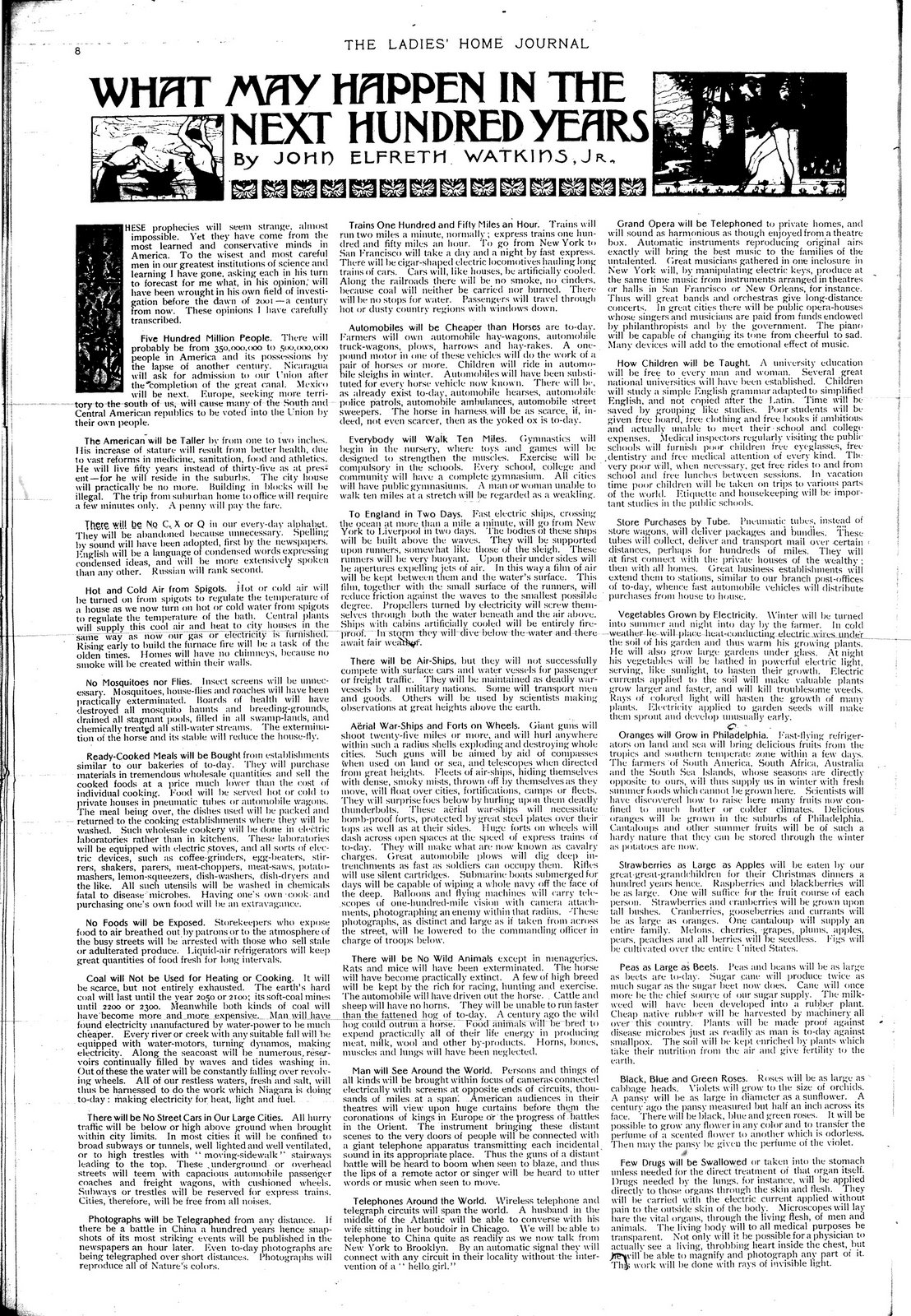
Alexander Rose, from the Long Now Foundation points us to an article from the Ladies' Home Journal, published in 1900: "What May Happen in the Next 100 Years." Some of the predictions seem remarkably prescient, such as "Photographs will be telegraphed from any distance" or "Wireless telephone and telegraph circuits will span the world." Others, comically wrong ("Everyone will walk 10 miles a day"). A few are just bizarre, especially the author's obsession with gigantic food (peas as large as beets, strawberries the size of apples, and "One cantaloup [sic] will supply an entire family." WTF?)

Perhaps unsurprisingly, the author is most accurate where he is extrapolating from well established technologies of the day. Predicting that the telephone, telegraph, and railroad would all get better is pretty safe. His population forecasts are pretty good, but they are a bit high because he failed to predict the drop in fertility rates that accompanied industrialization. He does less well with technologies like aviation, which had not yet taken hold, vastly underestimating their prominence. Technologies yet unimagined in 1900, such as transistors and integrated circuits, are completely absent from his predictions, and when it comes to cultural trends he is all over the map.

Contemporary futurists can take some lessons from these predictions. Incremental improvements to existing technologies are easy to predict, but tend to underestimate the scope of technological progress. The real revolutions will come from new technologies not in common use today. Some of them, like aviation in 1900, may be right on our doorstep. And people will remain as stubbornly unpredictable as ever.

There is one thing, however, that I feel pretty confident about: no giant fruits and vegetables, ever. You can take that one to the bank.

Sunday, December 2, 2007

Virtually Everyone is Sincere, but They Still Can't Agree

Over at EconLog, Bryan Caplan makes a discovery:

Since the publication of my book, I've been meeting a much wider range of people.
...
What have I learned? Primarily, I'm more convinced than ever that virtually everyone is sincere.
This is not terribly surprising to me. Robert Heinlein said it a long time ago: "Your enemy is never a villain in his own eyes Keep this in mind; it may offer a way to make him your friend," and he doubtless ripped that off from somewhere else much older. So, if we're all sincere, why do we disagree so vehemently, particularly about issues of politics? Caplan continues:
Even when you've got undeniable facts on your side, your opponents probably think that those facts don't matter...
I think Caplan is on to something here, but I think he doesn't go far enough. Often you won't even be able to get your opponents to agree on the facts in question. What fraction of taxes are paid by "the rich"? Does the Canadian health care system make people wait a long time for treatment or doesn't it? These are strictly positive questions that should have answers that everyone can agree on. Yet, when you listen to people argue about the issues surrounding these questions, often their versions of the facts are so different that if you didn't know better you'd conclude that they must live in two very different countries.

Even if we could agree on the facts, there would still be plenty of room for disagreement over the normative aspects of the problem, but if you can't agree with your opponent over the basic facts surrounding the problem, then the argument probably isn't worth having in the first place.